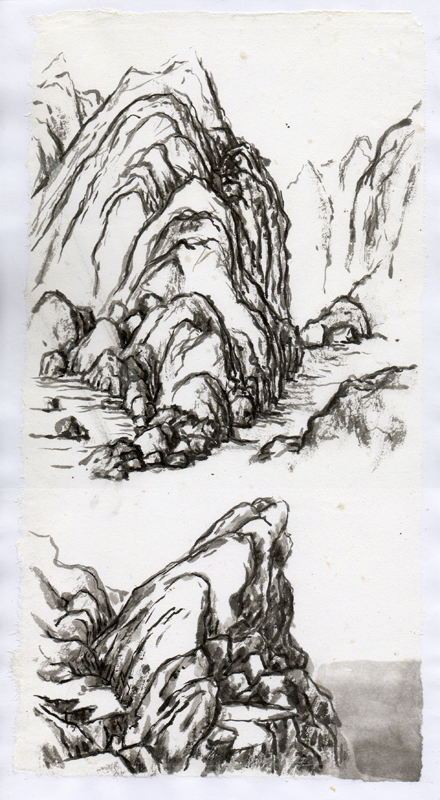
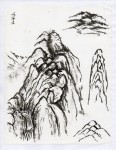
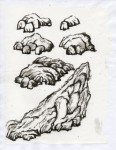
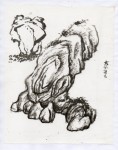
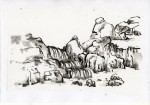
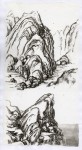
My second series from the manual The Mustard Seed Garden consists of rock studies. The progression from tress to rocks is not immediately perceived. However, after executing a few studies, one sees how the lively twisting branches, strong trunks and delicate leafage turn into massive rock bases with undulating hills and falling cascades.
My wrist is becoming more deft, I understand better how the mark of the ink is influenced by its wateriness and the absorbing paper can also capture dry and scratchy marks. There is still much to learn: I could do dozens of these studies. On the other hand, it’s more important to go on.
Lu Ch’ai said the main thing in painting rocks was that they should be alive. Each brushstroke should move and turn, with abrupt stops, sinuous as a dragon. The quality of spirit (ch’i) is as basic as the way they are formed. They are the framework of the heavens and the roots of the clouds.
As with the four main branches of a tree the principle of distinguishing the three faces of a rock contains the essence of the tao of painting. Trees have one kind of intersecting lines, rocks another. In trees it is the ramification of branches, in rocks the markings of their veins. Large and small rocks mingle and are related like the pieces on a chessboard. Small rocks near water are like children gathered around with arms outstretched toward the mother rock. There is kinship among rocks.