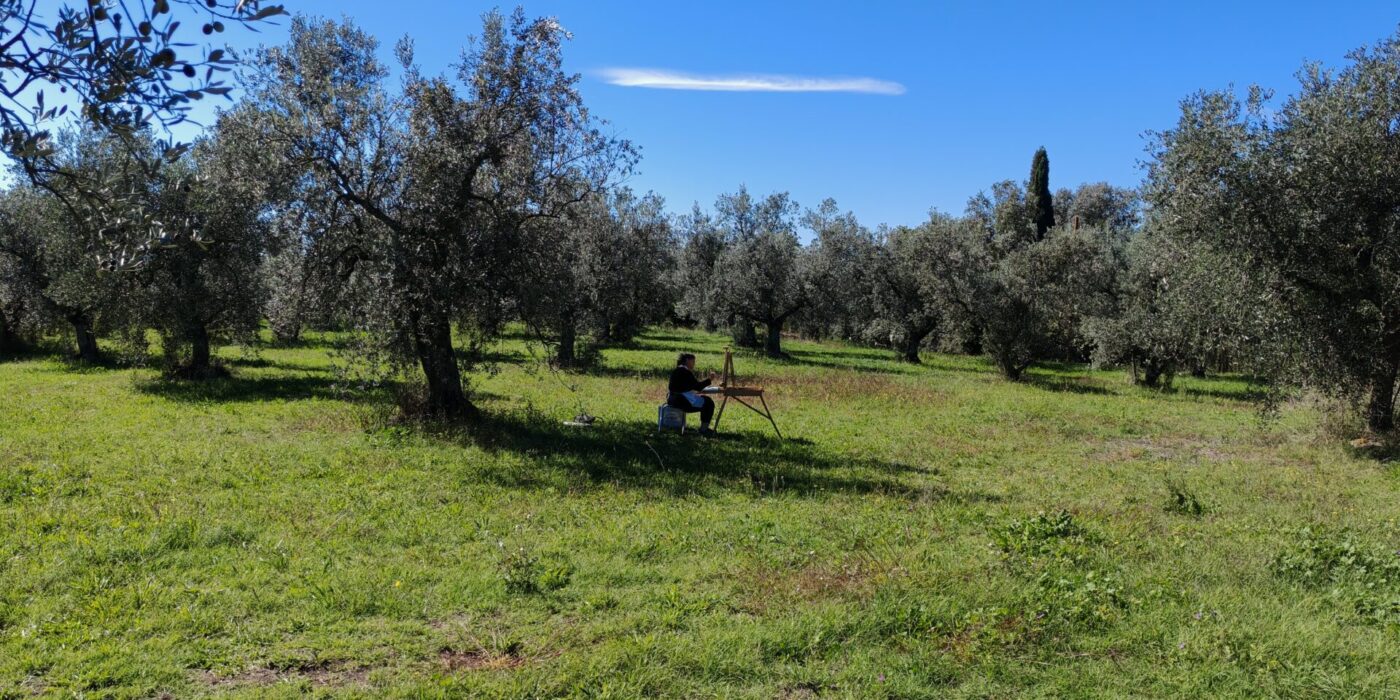
Cézanne’s lesson.
Plein air painting is practical: it’s first and foremost about having a sustained experience over time, so it’s necessary to let go of the idea of creating a “painting”!
Regarding plein air painting, we must rediscover the painters’ primary inspiration, particularly that of Cézanne, the man who fully realized it.
The question of the subject.
Plein air painting can be done on any subject, but as you progress, the search for the subject becomes a completely personal matter, one that already reveals the purpose of your work.
Unlike studio painting, in plein air painting the subject has no literary or content-related motivations, but depends solely on the eye of the observer.
For Cézanne, who developed his entire painting style en plein air, the subject is “Motif,” the reason, the pretext that leads to painting; it is what captures the eye because it contains formal elements that lead to beauty. In this case, painting will simply make this internal process manifest, so that others, seeing the painting, can retrace it. To be convincing to a stranger, the motif must first convince the painter.
For this reason, motif is the foundation of painting; a painter who paints en plein air without motif is like a writer without a subject; he may perform formal acrobatics, but the work will always lack a reason. This explains why, often, once a painter finds a motif, he is never far from it; he is capable of working on the same motif for a long time.
Motif must be sought; it is not easily found, and its search is not just about feeling; to be a fully pictorial pursuit, it must evolve from personal sentiment to the emotion aroused by the light itself.
Only from this emotion can we make a personal choice, which concerns the framing. Indeed, not all of the scene before us is worthy of being depicted; within it, we must therefore select what truly strikes us.
When searching for motifs, it’s easy to err by allowing ourselves to be influenced by certain stereotypical images of landscape, which are our common heritage, originating from certain commercial paintings or even photographs, and which in painting are labeled “picturesque.” Art history, the Impressionists and the Macchiaioli, come to our aid in this regard.
Cézanne exhorts us to consider everything as “cone, cylinder, and sphere,” that is, as geometric solids. To free ourselves from banal and superficial descriptions, we must eliminate everything “extra,” which prevents a substantial identification of the subject, starting with the details.
The motif must be approached in this way, seeking form, light, and color (in that order) and transcribing it according to a composition through a geometric design that highlights the fundamental lines in the overall view.
The painting is then created in patches; this is not the normal process of glazing, but rather a more substantial material, being alla prima.
The common perception of color is immediate and instinctive, and the same instinct must be sought in the mixing of colors on the palette, countering reasoning: choosing a color does not require reasoning but a strong sensation, which is hindered by a priori knowledge. Any knowledge must be tested by personal experience; only in this way can one learn to paint.
Of course, this cannot be expected from the beginning, since the sensation of color strengthens the more it is practiced.
The patches are painted in succession, starting from a point and spreading across the support in the direction preferred, but always together, using the previous patch as a reference point for the next, continually comparing them.
Once the entire surface of the painting has been filled in this way, the study has reached a first stage, and once examined and corrected, it can be considered complete.
A study can be considered successful when it respects the shapes, contrasts, and colors; only then does the new image “work” and is governed by harmony.
A plein air session should not last more than an hour, because after this time the light changes completely; if you want to continue the work, you can gradually reduce the spots, preferably in subsequent sessions, but taking care not to lose the sense of freshness and harmony achieved.
Let’s be clear: a certain lighting condition belongs only to a particular moment and day; as such, it will never be repeated. Therefore, persisting with a painting is often not productive but frustrating; it’s better to start a new one.
A plein air work doesn’t have to be “finished.” One of the reasons for impression painting was precisely that it was an alternative to “content” painting.
Oil Paints
Painting en plein air, especially with oil paints, is like camping: it’s essential to be organized, to be able to adapt to the different situations that arise, and to make a thoughtful list of materials, which you should always keep with you and check and update every time you move to paint.
Plein air painting pushes you outdoors, searching for a place to paint. Therefore, it’s important to consider the weight of your equipment first, looking for lightweight materials, aluminum easels and stools, plywood or disposable palettes, a basic palette of paints in small tubes, a few brushes of various sizes, a single rag, and a plywood or aluminum box.
It’s also important to find solutions for transporting still-dry paintings.
Painting while standing helps you maintain a clear overall view, often moving away from the easel and contemplating the painting from a distance, since a comprehensive view is more essential than ever. If you’re forced to paint while sitting, don’t forget to get up occasionally to check your work from afar.
The classic “French” easel is made of wood and consists of a box with three foldable legs underneath, which holds all the necessary materials. The box has a drawer that slides out toward the painter, where the palette is placed.
This type of field easel is convenient because it provides a perfect and stable support surface, is also suitable for medium-large formats, and solves the problem of transporting a fresh painting, which, once finished, can be turned inside out with the painted surface facing inward.
All other solutions are suitable for small studios.
The photographer’s easel with a tripod, inserted under the box, is generally more expensive and takes up less space, although it weighs just as much as a classic easel.
Other tripod easels, made of wood or aluminum, require a separate material box and a stool on which to rest the palette while standing.
Finally, for truly quick, sketch-style painting, you can paint, standing or sitting, using just the paint box. The paint box’s lid, held vertically in place, is secured with rubber pads or double-sided tape.
A recommended medium for plein air painting is a wooden or cardboard board or a small canvas panel, in addition to stretched canvas. Substrates other than pre-prepared canvas, such as paper, cardboard, or wood, do not necessarily need to be primed (with gesso and glue/additional varnish on the palette), but simply a coat of linseed oil.
The Palette.
We must think of the palette as the painter’s soul. The entire work is decided on its surface, so it’s essential that it be equipped for every eventuality. But what matters, even more than the colors on its edges, from which we begin, is the work that takes place at its center, that is, their mixing.
Colors should be limited in number and tube size. To begin, two shades of each primary color and the three most transparent earth colors are essential, to which emerald green and violet (cobalt, mineral, etc.) can be added:
1-Titanium White
2-Lemon Yellow
3-Cadmium Yellow Medium
4-Vermillion Red
5-Carmine Red
6-Ultramarine Blue
7-Phthalo Blue
8-Natural Raw Umber
9-Natural Raw Sienna
10-Earth Green
The painter’s job is to seek out the greatest possible number of colors in natural phenomena, and there’s always the feeling of seeing more colors than are available.
Preparing a palette in advance with colors that can be stored in jars (particularly tempera or acrylic paints) can be quite a challenge. For plein air painting, you should have plenty of greens, but especially the right ones; bright greens from a tube are rarely suitable.
The highlights on tree trunks can also vary from gray to Naples yellow and even bright orange or red.
A limited palette can be a good exercise, as it forces you to choose colors and enlarge the spots. A possible ready-made palette might look like this:
For the sky: Cobalt Ultramarine Blue (towards purple) / Turquoise or Cerulean Blue (towards green)
For vegetation: light green with lemon yellow / light green with ochre; medium Cobalt Green / Bladder Green; dark Emerald Green (towards blue) / dark green with raw umber.
For buildings: Light colors: white + light Naples yellow / reddish Naples yellow / orange / red. Darks: bluish ultramarine + reddish/purple earth * raw umber
The oil paint palette, inserted into the box of the French field easel is made of wood with a thumbhole for holding it, but it can also be simply a wooden board resting on the easel. Disposable palettes, made of glued blocks of waterproof paper, are very convenient because they save the effort of cleaning, but they are less stable.
After each session, the palette should be cleaned in its center. The paint can be recovered with the palette knife and saved for preparing the supports, or reused in the next session as a neutral gray, or mixed again with the new colors being composed.
The paint left on the edges can be left there if you paint frequently; otherwise, they should be thrown away or stored in resealable containers, as oil paints do not dry quickly.
Medium.
There are various mediums for oil painting, but in this case they can be reduced to two: linseed oil and odorless white spirit. The former is used to dilute the colors and should be used sparingly. The second is used to clean the brushes, both during and after work.
The two mediums should be poured into the appropriate resealable metal containers attached to the edge of the palette and replaced when they become dirty.
Brushes.
The brushstroke is another important element that characterizes the painter. The paint, whether brush or palette knife, should be placed on the support, never swiped.
Light is released by the coloring material differently, depending on the type of brushstroke. A generous stroke of the palette knife creates maximum luminosity, while a swipe of diluted color remains as transparent as watercolor.
Brushes for oil painting must be long, to allow for the right distance from the canvas. Brushes should be held in the left hand, along with a rag for quick cleaning from time to time. The number of brushes is arbitrary, but you should not work with more than five in one hand. They can be soft or hard, made of natural or synthetic hair, large and medium-sized flat brushes, and a small round one.
For oil painting, a palette knife is used along with brushes, so it’s a good idea to have three: a large one for scooping paint from the palette, a medium one, and a small one.
Oil paint stains clothing irreversibly, so don’t work without an apron. It’s also important to have rags, which are used for cleaning brushes during and after painting.
If possible, avoid painting in the sun to avoid glare. For this purpose, you can use an umbrella attached to your easel or at least a visor hat.
Laura Grosso