For painting, natural phenomena constitute the image of the visible, Eikon (icon).
The history of Eikon, paradoxically, begins around 700 AD precisely with its denial (iconoclasm), when Christianity, the mystery of God’s incarnation, opposing the ban on images in Greek and Jewish cultures, not only permitted but actually encouraged and supported Eikon to the point of adopting it as a caption to Sacred Scripture, beginning with that first icon depicting the Virgin and Child, believed to be the work of the evangelist Luke.
The Eikon is an image that refers to the Truth as the creature refers to the Creator; through the type (man) we access the prototype (Son of Man), through the face of Christ we access God.
Painting aims to demonstrate transcendence because it is closely linked to light, which in Latin has two meanings, defined by two different words:
Lumen, the inner light that emanates from the eye, illuminating the phenomenon
Lux, the outer light that illuminates the phenomenon
Light as Lumen originates from the human being and casts light upon the world, requiring the person to play an active role; light as Lux originates from the world and casts light upon the human being, who remains passive, welcoming and reflecting it.
Until the Middle Ages, light (Lumen) came from the eye, understood as the organ of the transocular soul, which radiates upon the phenomenon, merges with it, and absorbs its colors. This light does not cast shadows; it produces a radiant image, whose internal splendor, not determined by an external source, is intended to bear witness to a transcendent reality.
Things changed starting with the Renaissance.
The visual cone reverses: light (Lux) becomes external, coming from an external source, illuminating the phenomenon and projecting into the eye, imprinting its image on the retina.
The eye, circumscribed by the eyeball, is merely an instrument capable of perceiving it, the sense organ that records the phenomenon. In this process, the eye becomes the absolute protagonist, confining the totality of the person to passivity, until the person completely loses their inner light, and with it their connaturality with the phenomenon itself.
The deviation of the gaze towards Lux also subordinates it to the various scientific discoveries that follow one another over time: perspective, anatomy, the microscope, the telescope, photography.
A gaze that is no longer ascetic, no longer oriented toward the transfiguration of the phenomenon through substantial and profound contact, becomes easy prey to illusion and inevitably turns toward simulation and imitation.
The search for this type of light involves identifying the external source, resulting in a vision dominated by chiaroscuro and extremely contrasting, which reaches its peak in the Baroque period and continues without significant change until the twentieth century.
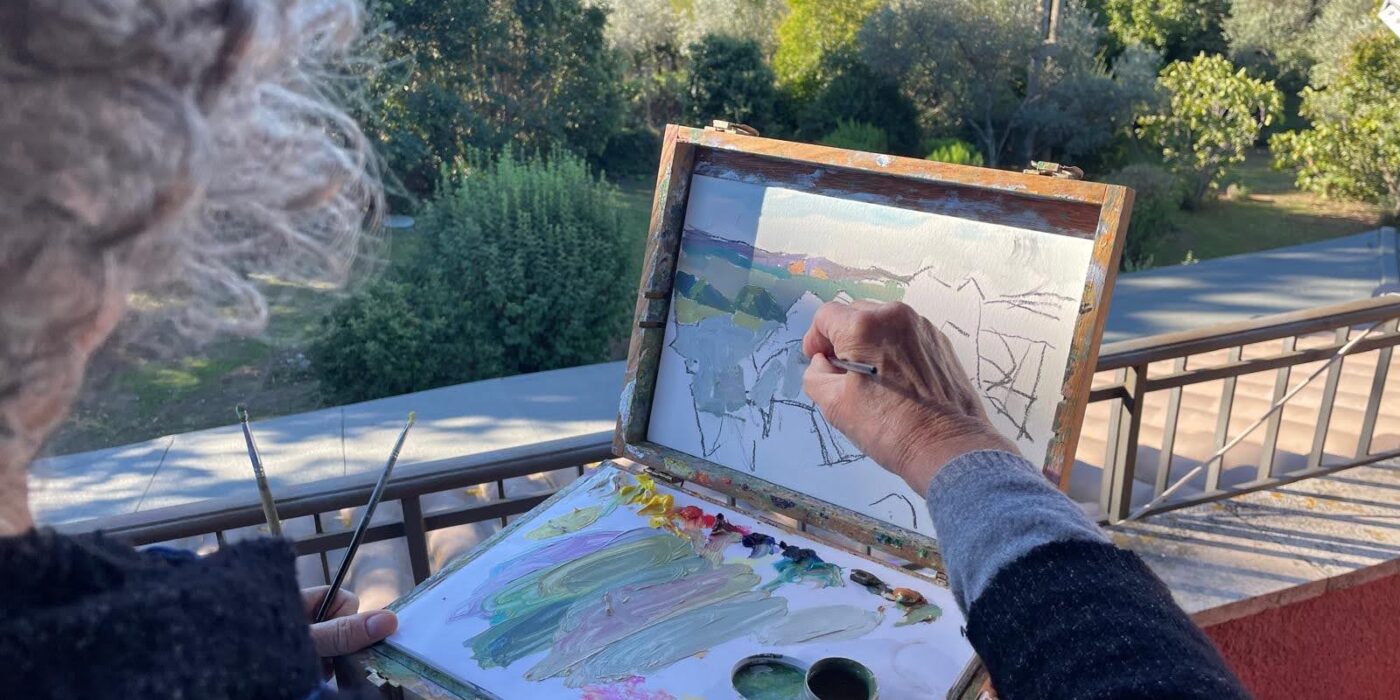
Properly painting en plein air means returning the eye to the Lumen.
The eye trained in observing natural phenomena is not only very different from one focused on Lux, but above all, it is initiated into an effective understanding of the elements of painting—line, tone, and color—at the same time that the hand, forced to adapt to the rapidly changing light, acquires flexibility and skill.
It was initially the Romantic spirit that drove painters away from the city and emerging technology, with the sole intent of chasing the changing sunlight, of capturing, in that continuous movement, in that sudden acceleration, a unique moment in the passing of the seasons.
But artificially blocking vision, as in a photograph, still responds to a gaze directed toward the Lux, while in reality, in natural phenomena, it is impossible to identify the source of light for more than a moment, as it continually shifts.
In this sense, even the paintings of the Impressionists, though technically different from earlier landscapes, with their vague forms, sketched by those typical, rapid, darting brushstrokes intended to capture the light of a moment, still respond to the old type of image.
There is nothing more free and liberating than painting en plein air.
Painting “en plein air,” painting in the open air, has been presented from the beginning as an alternative to painting in the “studio,” but the significance of this innovation is not properly understood if it is understood only as a change of subject: painting en plein air means shifting the focus from the subject to the light; in this sense, it is the main path for painting, without which painting enters into crisis as an art in its own right.
The practice of en plein air became popular starting in the 19th century almost everywhere, but particularly in France with the Barbizon school and in Italy with the Macchiaioli. Painters came together in groups, within which the purpose of painting began to shift beyond the reproduction of the Image.
This reflection becomes especially necessary following the new invention of the mechanical “eye,” the photographic lens, as well as scientific discoveries regarding light and new theories of color.
The Impressionists waged a real battle; the en plein air method, from a simple alternative, became a courageous stand against the academy, creating a scandal for which each of them bore the brunt.
En plein air research constituted a challenge: capturing all the nuances of color, to convey visual perceptions and sensations, in the limited time offered by the passage of light.
In this new perspective, the technique also had to be reformulated; the glaze technique proved unsuitable; a rapid technique of short, spontaneous brushstrokes, “alla prima,” became indispensable.
It became imperative to always paint a work at the same time of day, and consequently to work on multiple works simultaneously and in rotation, on an increasingly smaller format to complete the work quickly.
These small studies aim to compete fearlessly with the large museum canvases.
However, only Cézanne’s “Petit Sensations” manage to fully direct the eye toward the Lumen, and for this reason we consider him the true watershed between ancient and modern painting.
These small sensations of color arise through contemplation and the concentration of prolonged and intense observation of the phenomenon. Through the pursuit of his small sensations, Cézanne sought, as a painter, to achieve the transformation of visual perception caused by external light and induced by the subject into a particular type of perception that primarily engages the soul and, as such, while firmly based on the visual, is capable of transcendence.
In natural phenomena, what we see depends on the movement of the sun, which creates ever-changing luminosity, colors, and shapes. Painting, through the active work of the eye, is called upon to convey precise visual perceptions, each color applied precisely in its place, to produce a new image that appears illuminated from within rather than from an external source.
Returning to plein air painting offers a renewal. It aims to acquire the specific foundations of painting in the relationships between different lines, different tones, and different colors, correlating these elements, unifying all perceptions and allowing them to flow into a new image, personal yet non-arbitrary.
Practiced in this way, plein air painting teaches not only how to see and paint, but also how to understand the essence of painting.
For example, it requires moving beyond purely aesthetic drawing, an end in itself, to seek a drawing that is more functional to painting, one that can adapt to the passage of light, that responds to the juxtaposition of lines that appear as it passes, that provides a framework for the composition. A drawing that, starting from the precise identification of the portion of reality, emerges from the boundaries between solids and voids and from tonal contrasts, in which no one part predominates, that itself pursues solely the principle of harmony that governs nature.
Laura Grosso